SHIFT: Selected Helpful Informative Frame for Video-guided Machine Translation

Published in CCF B EMNLP 2025, 2025

Abstract

Video-guided Machine Translation (VMT) aims to improve translation quality by integrating contextual information from paired short video clips. Mainstream VMT approaches typically incorporate multimodal information by uniformly sampling frames from the input videos. However, this paradigm frequently incurs significant computational overhead and introduces redundant multimodal content, which degrades both efficiency and translation quality. To tackle these challenges, we propose SHIFT (Selected Helpful Informative Frame for Translation). It is a lightweight, plug-and-play framework designed for VMT with Multimodal Large Language Models (MLLMs). SHIFT adaptively selects a single informative key frame when visual context is necessary; otherwise, it relies solely on textual input. This process is guided by a dedicated clustering module and a selector module. Experimental results demonstrate that SHIFT enhances the performance of MLLMs on the VMT task while simultaneously reducing computational cost, without sacrificing generalization ability. The code will be released upon acceptance.

SHIFT


The Construction Process of TriFin
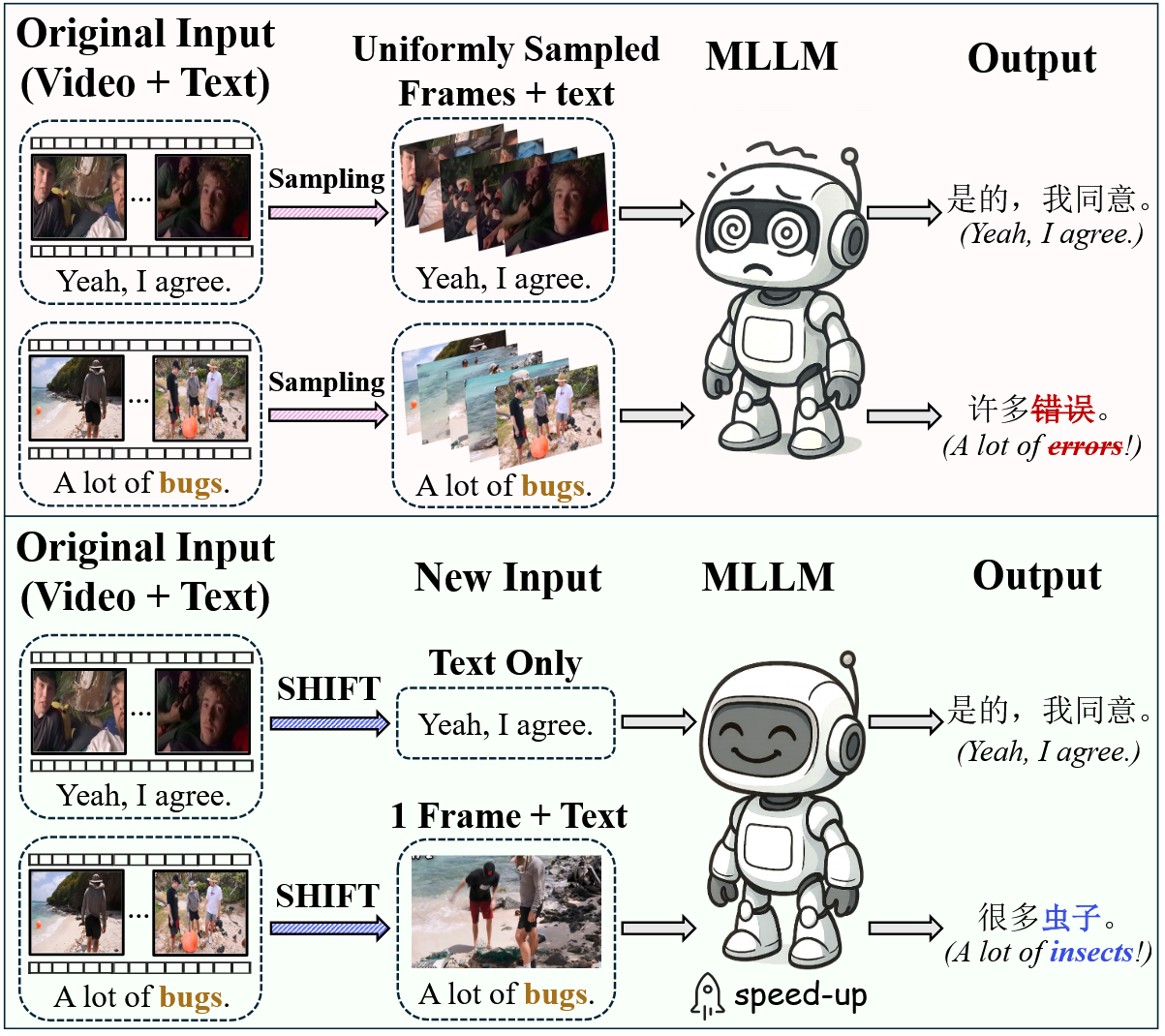
Comparison of the conventional VMT paradigm (top) and our SHIFT framework (bottom). The conventional VMT paradigm translates the subtitle text by jointly processing uniformly sampled frames. In contrast, SHIFT employs text-only inputs for simple cases and selects one key video frame when visual context is required (e.g., ambiguous word “bug”). Blue/red indicate correct/incorrect translations.


Statistics of the TriFine Dataset
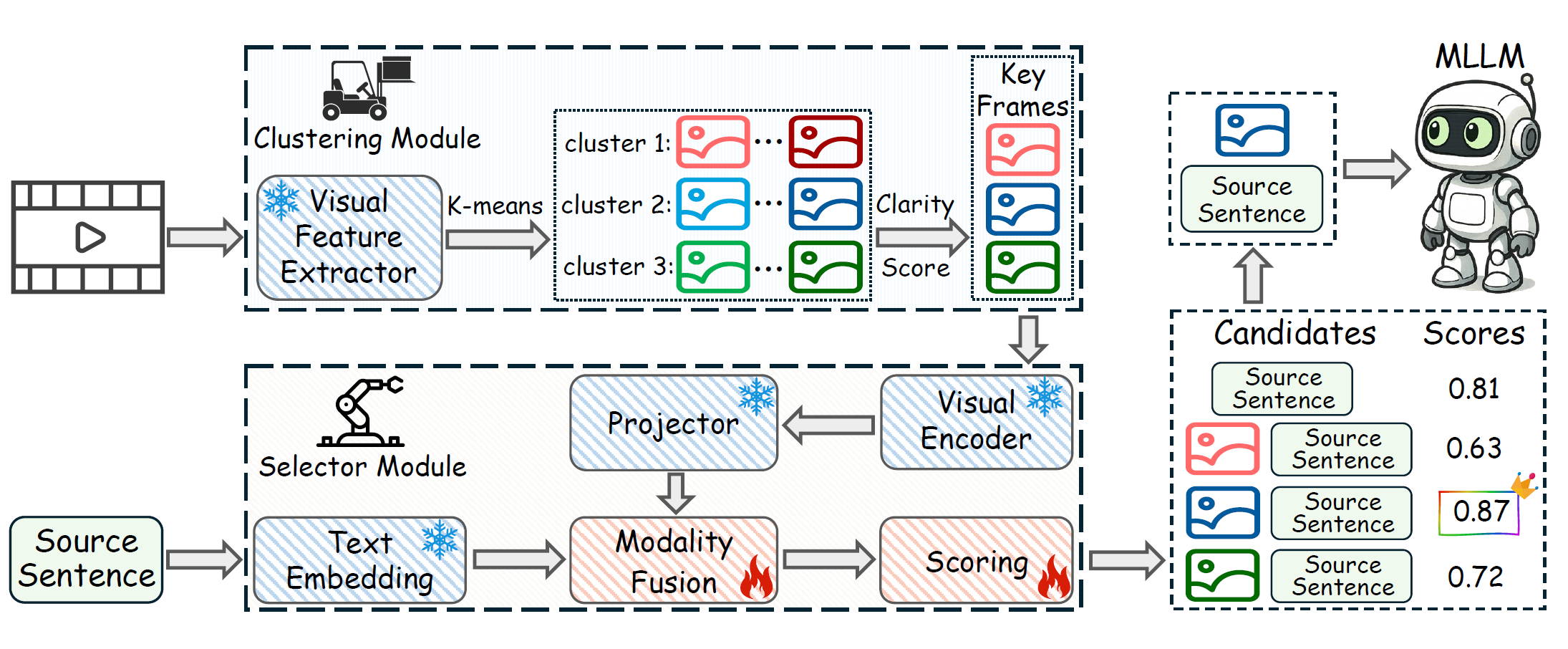
Overview of the SHIFT framework, consisting of a clustering module and a selector module. The clustering module groups frames into K clusters (e.g., K=3 in the figure) based on visual features, and selects the clearest frame from each cluster as a key frame. The selector module scores K key frame–text pairs and a text-only input; the top-scoring input is used for inference. Only the modality fusion layer and scoring head is trainable (indicated by flame), while all other components remain frozen (denoted by snowflake).


Statistical comparison between the TriFine dataset and other VMT datasets
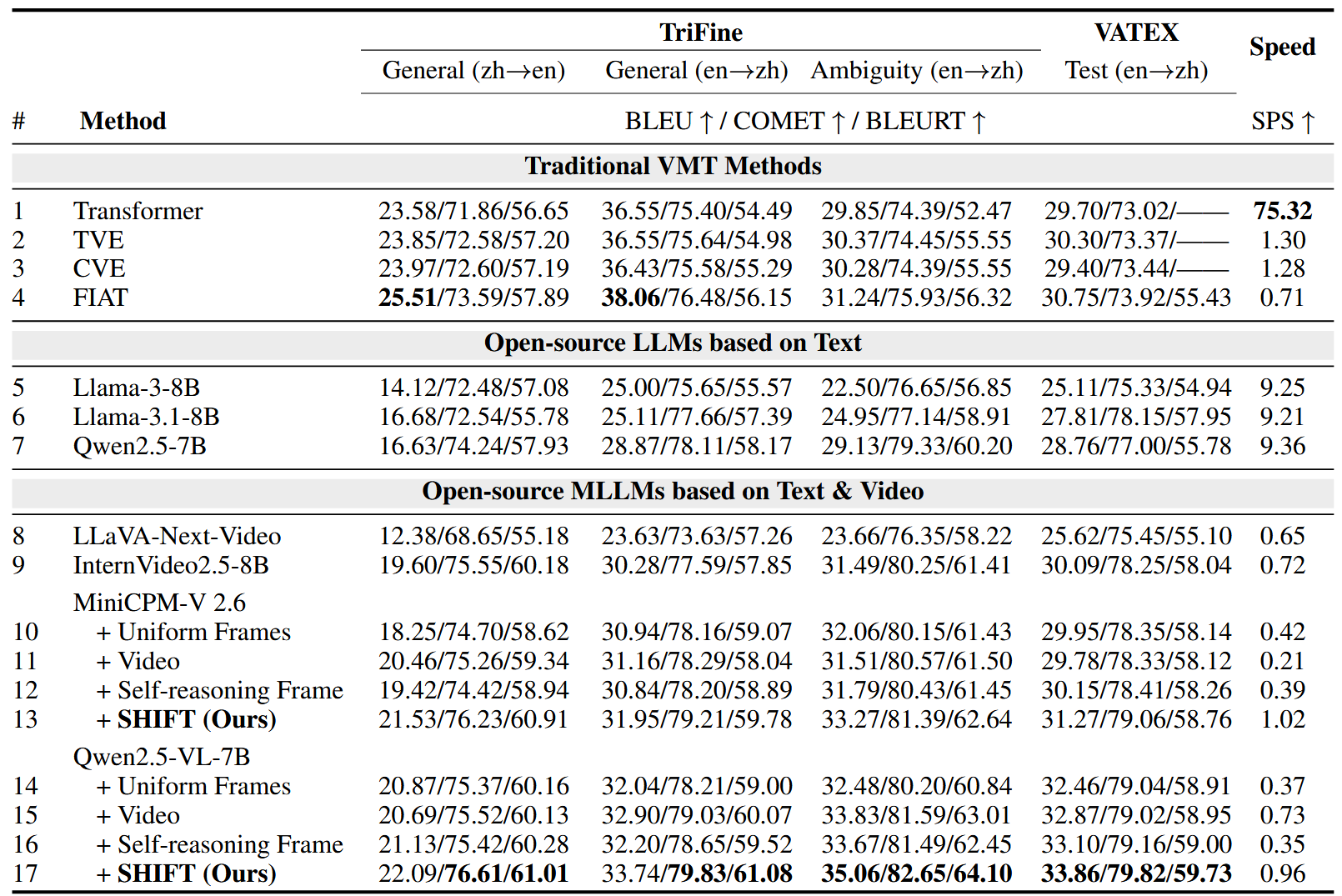
Results of methods on the TriFine en-zh general test sets, the ambiguity test set, and VATEX test set, averaged over three random seeds. SPS (Samples Per Second) denotes the average inference speed. The best value for each metric on each test set is highlighted in bold.


FIAT framework architecture
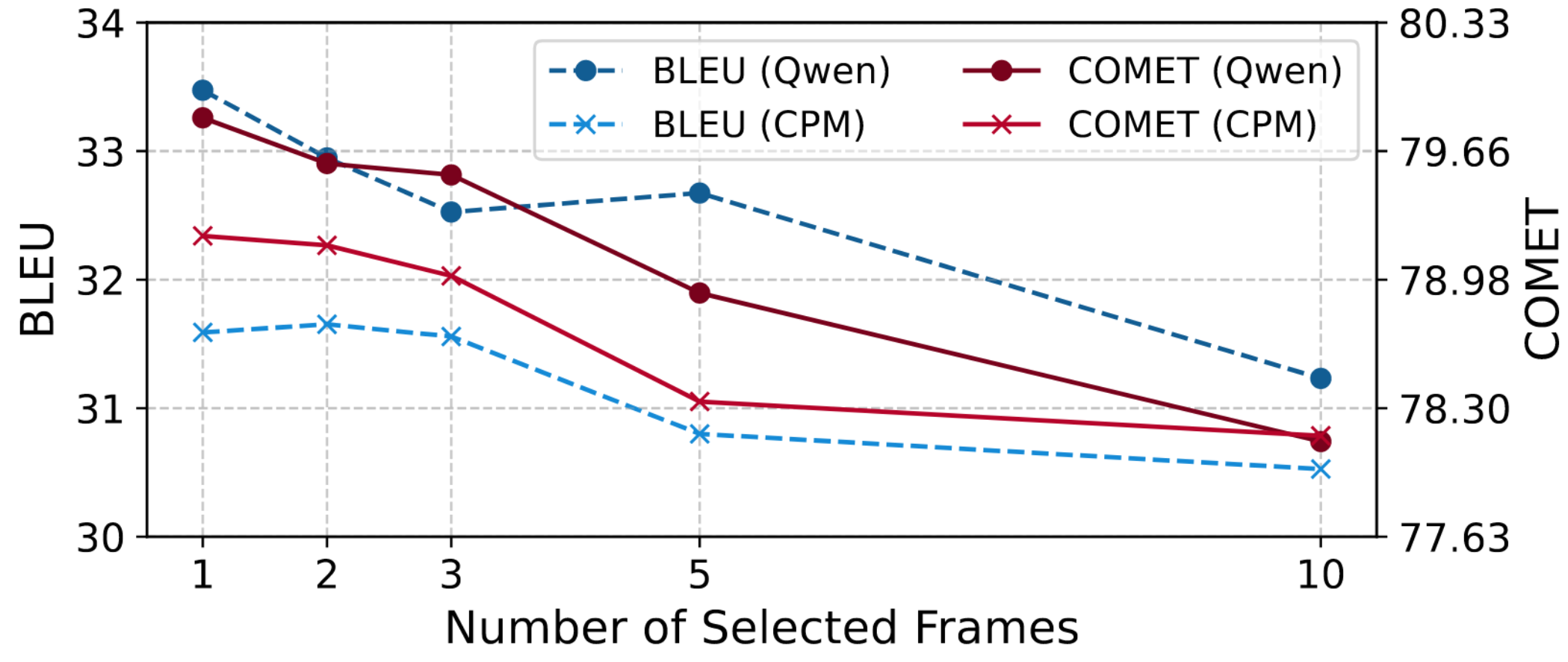
BLEU and COMET scores of Qwen2.5-VL7B and MiniCPM-V2.6 with different frame counts on the TriFine en→zh general test set.


Recommended citation: SHIFT: Selected Helpful Informative Frame for Video-guided Machine Translation (Guan et al., EMNLP 2025)
Download Paper | Code